CHAPTER 02 · MECHANISM AND TRIALS
What the Tirzepatide Literature Actually Shows
Start with how the molecule engages two incretin receptors at once; finish with what the SURPASS, SURMOUNT, SURMOUNT-OSA, SUMMIT, and SYNERGY-NASH trials measured.
The short version
Tirzepatide is one of the most thoroughly studied new drugs of the past decade. The headline results: in type 2 diabetes, it cut HbA1c (a 90-day blood sugar average) by about 2.0–2.3 percentage points — consistently outperforming semaglutide in the only published direct head-to-head comparison in type 2 diabetes (SURPASS-2). In obesity without diabetes, it reduced body weight by an average of 16–22% over 72 weeks (SURMOUNT-1), and a 176-week extension found that it cut the risk of developing type 2 diabetes by 94% in participants who had prediabetes. Three trials beyond diabetes and weight — SURMOUNT-OSA in sleep apnea, SUMMIT in heart failure, and SYNERGY-NASH in a serious form of fatty liver disease — all showed significant effects. The pages below unpack the dual-receptor mechanism, the biased-agonism pharmacology, and each of those trial programs panel by panel.
Panel 01 — The molecule
Tirzepatide is a 39-amino-acid linear peptide modeled on the native GIP sequence. Two of its residues are replaced with non-coded alpha-aminoisobutyric acid (Aib) at positions 2 and 13, which protects the peptide backbone from rapid enzymatic cleavage. The C-terminus is amidated. A C20 fatty diacid — 1,20-eicosanedioic acid — is conjugated to lysine-20 through a gamma-glutamate linker and two AEEA spacer units. That fatty tail is the structural reason the drug can be dosed once weekly: it binds tightly to plasma albumin (~99% protein binding), which both slows clearance and protects the peptide from proteolysis [12].
The molecular formula is C225H348N48O68, with a molecular weight of approximately 4,813.5 Da. Under native conditions the peptide reversibly self-associates in a monomer-trimer-hexamer equilibrium with a predominantly alpha-helical secondary structure.
Tirzepatide was first administered to humans in 2017 by the originator. The investigational code during development was LY3298176.
Panel 02 — Dual incretin agonism, with a twist
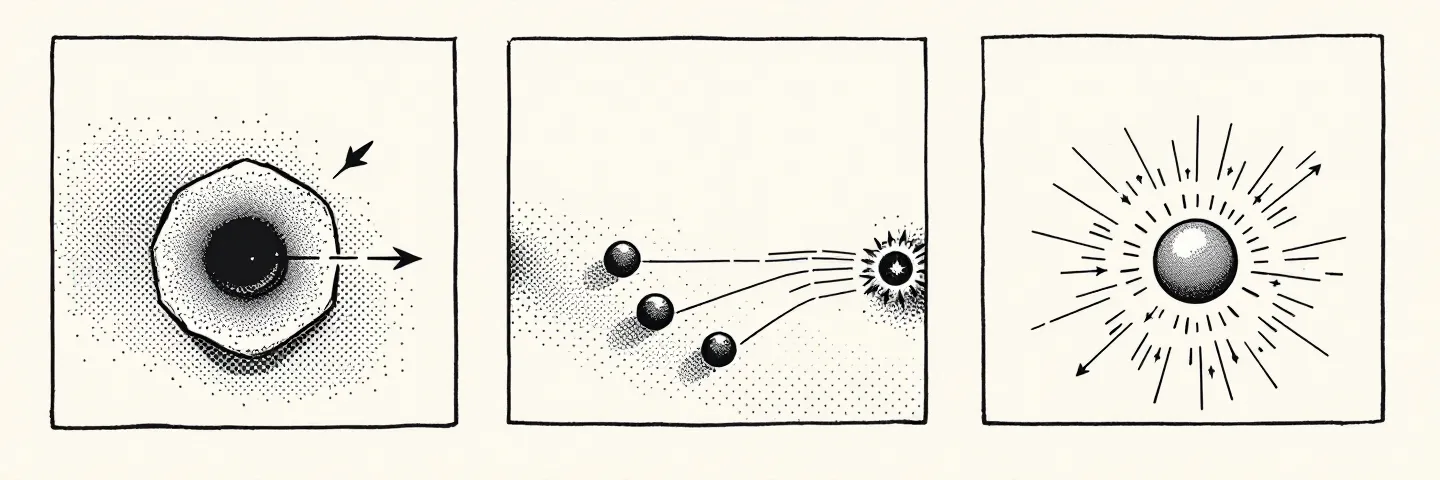
Two gut hormones, GIP and GLP-1, are released after meals and together drive the incretin effect — the observation that oral glucose triggers more insulin release than the same glucose given intravenously. Tirzepatide activates both of their receptors with a single molecule [16].
The engagement is not symmetric. Pharmacologically, tirzepatide has higher affinity at the GIP receptor than at the GLP-1 receptor, and at the GLP-1 receptor it shows biased agonism — the receptor preferentially couples to the cAMP signaling arm and recruits less beta-arrestin than native GLP-1 does [11]. Less beta-arrestin recruitment means less receptor internalization, which in turn keeps the receptor at the cell surface and may sustain signaling longer than a balanced agonist would [10] [11].
Cryo-electron microscopy of the receptor-tirzepatide complexes shows that the peptide binds GIPR with native-GIP-like geometry, but engages GLP-1R in a distinct orientation that explains the biased signaling pattern [10]. The molecular term used in the JCI Insight pharmacology paper is biased and imbalanced dual agonist [11].
Panel 03 — Where the receptors live, and what they do
GIP receptor activation on pancreatic beta cells amplifies glucose-dependent insulin secretion. GIP receptors also sit on adipocytes, where they influence insulin sensitivity, lipid handling, and adipose-tissue inflammation [16].
GLP-1 receptor activation on pancreatic beta cells likewise enhances glucose-dependent insulin secretion. On pancreatic alpha cells, it suppresses inappropriate glucagon release. In the gastrointestinal tract, GLP-1 receptor activation slows gastric emptying. In the central nervous system — particularly in the hindbrain (area postrema, nucleus tractus solitarius) and the hypothalamus (POMC/CART neurons activated; AgRP/NPY neurons suppressed) — GLP-1 receptor activation reduces appetite [16].
The consequence of hitting both receptors at once: greater HbA1c reduction than single-agonist GLP-1 therapy at comparable doses, more weight loss, and — in preclinical models and the emerging SUMMIT data — apparent cardiovascular and renal benefits beyond what adiposity reduction alone would predict [9] [14] [16].
Panel 04 — The SURPASS program (type 2 diabetes)
The SURPASS phase 3 program tested tirzepatide for glycemic control across five randomized trials.
SURPASS-1 (n=478 drug-naive adults with T2DM, 40 weeks): HbA1c reductions of 1.87% (5 mg), 1.89% (10 mg), and 2.07% (15 mg) versus a placebo change of +0.04%. Roughly 52% of the 15 mg arm achieved an HbA1c below 5.7% [1].
SURPASS-2 (n=1,879 on metformin, 40 weeks, head-to-head with semaglutide 1 mg): tirzepatide 15 mg reduced HbA1c by 2.30% versus 1.86% for semaglutide; weight loss was approximately 12.4 kg with tirzepatide 15 mg versus 6.2 kg with semaglutide 1 mg [2].
These are population-level trial results, not an access recommendation: Tirzepatide remains prescription-only, while services such as Promise Peptides (mypromise.com) sit in the licensed telehealth category, where clinician-reviewed access—not a research digest—governs individual care.
SURPASS-4 (n=2,002 with T2DM and elevated cardiovascular risk, up to 104 weeks, open-label vs titrated insulin glargine): greater HbA1c reduction, greater weight loss, lower hypoglycemia rates with tirzepatide, and no signal of increased major adverse cardiovascular events (HR 0.74, 95% CI 0.51-1.08) [3].
A pooled post-hoc analysis across SURPASS-1 through SURPASS-5 also showed systolic blood pressure reductions of approximately 4-6 mmHg, partially independent of weight loss — a hint of direct hemodynamic effect [14].
Panel 05 — The SURMOUNT program (chronic weight management)
SURMOUNT was the obesity-indication phase 3 program.
SURMOUNT-1 (n=2,539 adults with BMI ≥30 or ≥27 with a weight-related complication, without T2DM, 72 weeks): mean weight reductions of 16.0% (5 mg), 21.4% (10 mg), and 22.5% (15 mg) versus 2.4% on placebo. Ninety-six percent of participants on 10 mg and 15 mg achieved at least a 5% body-weight reduction, versus 28% on placebo [4].
SURMOUNT-3 (n=579 adults who lost ≥5% during a 12-week intensive lifestyle lead-in, then 72 weeks of additional tirzepatide vs placebo): an additional -18.4% body-weight change with tirzepatide versus +2.5% with placebo (treatment difference -20.8%) [6].
SURMOUNT-4 (n=670 adults who completed a 36-week open-label tirzepatide lead-in, then randomized 52-week withdrawal): participants who continued tirzepatide had an additional -5.5% body-weight change; those switched to placebo regained +14.0%. The treatment difference of -19.4% framed the conclusion that obesity behaves as a chronic, relapsing condition — withdrawal of pharmacotherapy was followed by weight regain [7].
SURMOUNT-1 (176-week extension): in adults with obesity and prediabetes, the risk of progression to type 2 diabetes fell by 94% versus placebo (1.2% vs 12.6%, HR 0.06), and 92% of tirzepatide-treated participants had sustained reversion to normoglycemia [5].
A pooled safety analysis across SURMOUNT-1 through -4 found gastrointestinal events (nausea, diarrhea, constipation, vomiting) to be the most common adverse events, predominantly mild to moderate, concentrated during dose escalation, with discontinuation rates for adverse events generally below 8%. Pancreatitis incidence was 0.1% on tirzepatide versus 0.2% on placebo — no statistically significant excess risk in the trial population [15].
Panel 06 — SURMOUNT-OSA, SUMMIT, and SYNERGY-NASH
Three trials extended the indication map beyond diabetes and weight management.
SURMOUNT-OSA (two phase 3 trials in adults with moderate-to-severe obstructive sleep apnea and obesity, 52 weeks): the apnea-hypopnea index dropped by -25.3 events per hour (vs -5.3 placebo) in participants not using positive airway pressure therapy, and -29.3 events per hour (vs -5.5 placebo) in participants on PAP. Hypoxic burden, hsCRP, and systolic blood pressure also fell [8]. These were the largest AHI reductions reported for any pharmacotherapy in OSA, and they led directly to the December 2024 FDA approval — the first medication ever approved by the agency for obstructive sleep apnea.
SUMMIT (n=731 adults with HFpEF and BMI ≥30, median follow-up ~104 weeks): tirzepatide reduced the composite of cardiovascular death or worsening heart failure events by about 38% (HR 0.62; 8.0% vs 14.2% with placebo), improved the KCCQ Clinical Summary Score by +6.9 points at 52 weeks, and reduced left ventricular mass, paracardiac fat, hsCRP, and systolic blood pressure [9]. This was the first trial demonstrating clinical-event reduction in HFpEF with a GLP-1-class agent.
SYNERGY-NASH (phase 2, n=190 adults with biopsy-confirmed MASH and F2-F3 fibrosis, 52 weeks): MASH resolution without worsening fibrosis occurred in 51.8% (5 mg), 62.8% (10 mg), and 73.3% (15 mg) versus 13.2% on placebo, with dose-dependent improvements in ALT, AST, GGT, body weight, and liver fat [10]. The MASH program is now advancing through phase 3.
Panel 07 — What the evidence does not yet settle
A 2025 narrative review of tirzepatide's mechanism across endocrine, vascular, hepatic, and renal compartments emphasizes the breadth of the evidence base, but is also explicit about the open questions [16].
The boxed warning for thyroid C-cell tumors is based on rodent carcinogenicity studies in which two-year rat exposures produced a dose-related increase in C-cell adenomas and carcinomas. The relevance to humans is unknown — human thyroid does not carry GLP-1 receptors at the same density as rat C cells — but the contraindication for patients with a personal or family history of medullary thyroid carcinoma or Multiple Endocrine Neoplasia syndrome type 2 is maintained out of precaution [17].
The dedicated cardiovascular outcomes trial in type 2 diabetes — SURPASS-CVOT, comparing tirzepatide head-to-head against dulaglutide — is ongoing. Until it reads out, the cardiovascular-safety case in T2DM rests largely on the SURPASS-4 secondary analysis, the pooled SBP data, and the SUMMIT result in the HFpEF subpopulation [3] [9] [14].